4 Reasons Tree Emergencies on the CT Shoreline Require a Climbing Specialist Not Just Any Crew

Mike James • June 30, 2026

When a tree comes down across a driveway in Branford, splits over a roofline in Madison, or leans dangerously toward a fence line in Guilford after a nor'easter, the homeowner's first instinct is to call whoever can get there fastest. What that instinct misses is that not every tree crew is equipped to handle every tree emergency, and the difference is not about how many trucks pull up. It is about how the crew can actually access and control the tree once they arrive.

Connecticut shoreline properties, particularly in the established neighborhoods of Branford, Madison, Guilford, and Old Saybrook, present a specific access challenge that distinguishes them from open rural lots or new-construction subdivisions with wide setbacks: mature trees growing in tight spaces, between structures, along narrow side yards, close to fences, and within reach of power lines, all on lots where a bucket truck or crane simply cannot get into position. When the emergency tree on the property is in one of these locations, which describes the majority of emergency calls on the CT Shoreline, a climbing specialist is not a premium upgrade. It is the only method that can safely complete the job.

This guide explains the four reasons why tree emergencies on Connecticut shoreline properties consistently require climbing specialists rather than equipment-dependent crews, and what that distinction means for a homeowner deciding who to call.

Reason 1: Bucket Trucks and Cranes Need Ground Access That Shoreline Lots Often Do Not Have

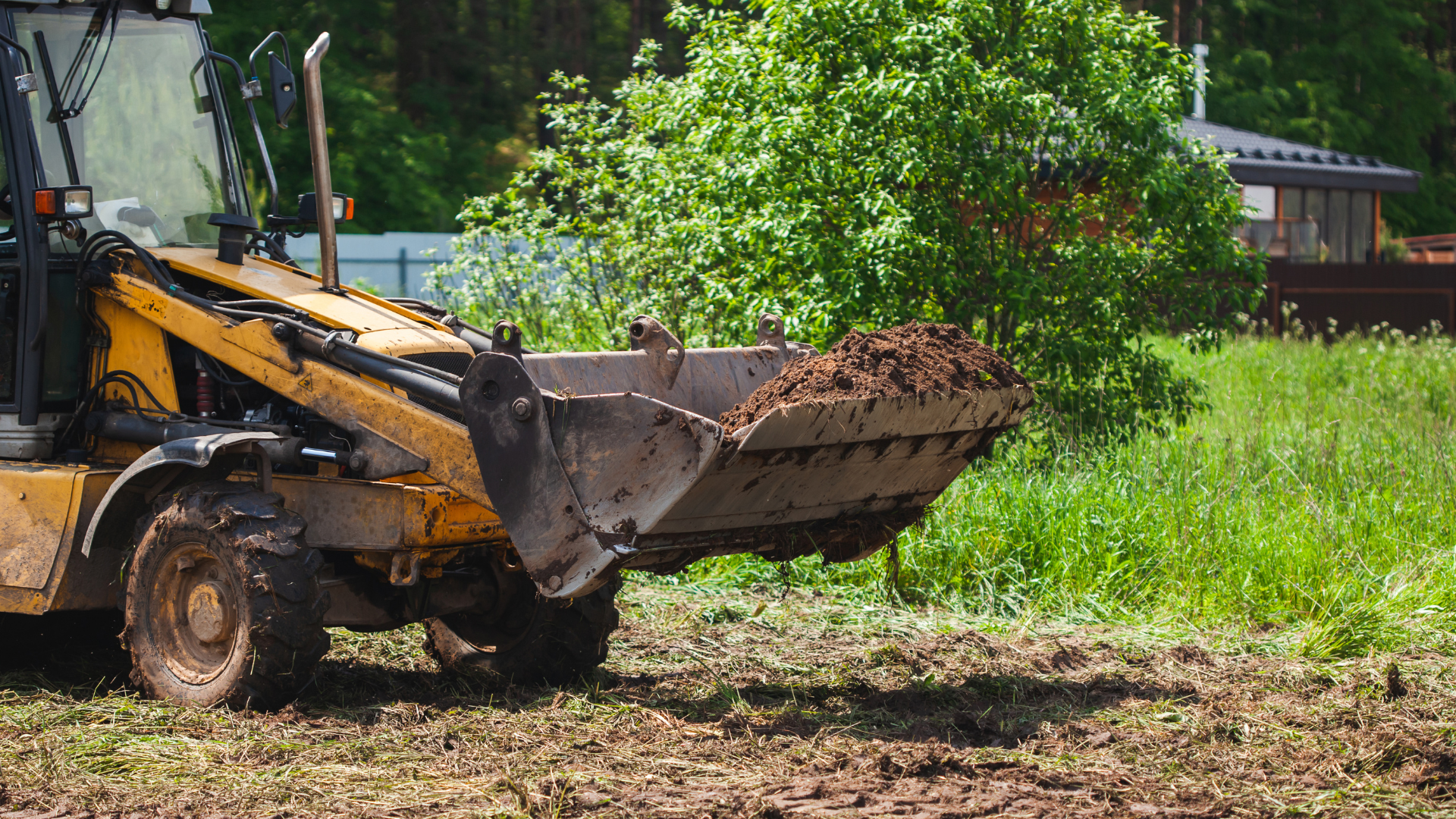
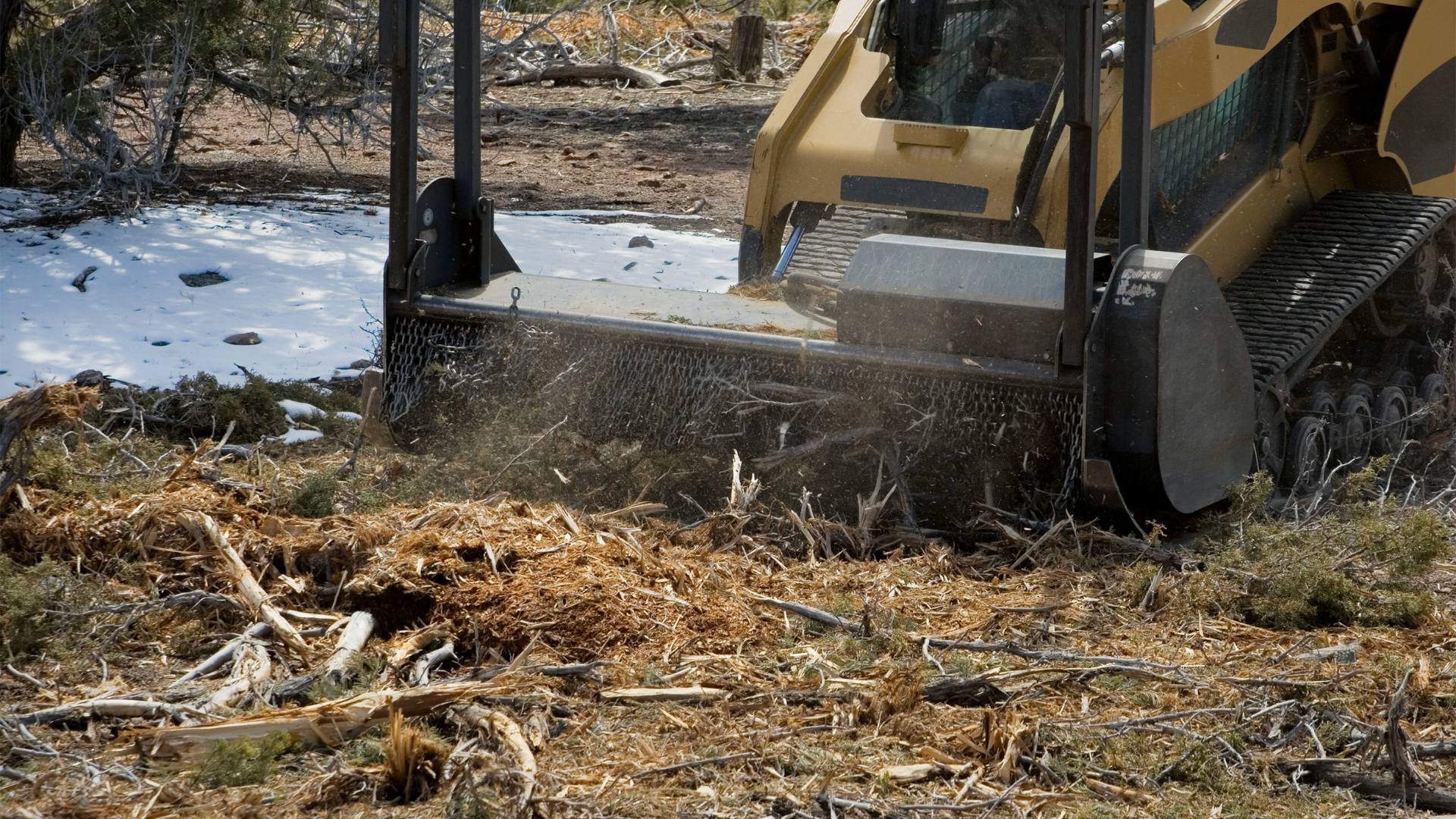
Bucket trucks and cranes are genuinely useful equipment for tree removal, and in the right setting, they reduce the amount of manual climbing and cutting a crew has to perform. But both pieces of equipment share a fundamental requirement that climbing does not: they need stable, accessible ground space to position the vehicle close enough to the tree to do the work.

A bucket truck is a vehicle with a boom lift, typically able to reach upwards of 50 feet, that allows a worker to be lifted to the tree rather than climbing it. It works well in environments where the truck can maneuver into position near the tree. A crane requires even more setup space, positioned on stable ground before any lift work begins, and is most useful in confined urban environments or near structures where its reach can lift sections up and over obstacles.

What this means for Branford, Madison, and Guilford properties specifically:

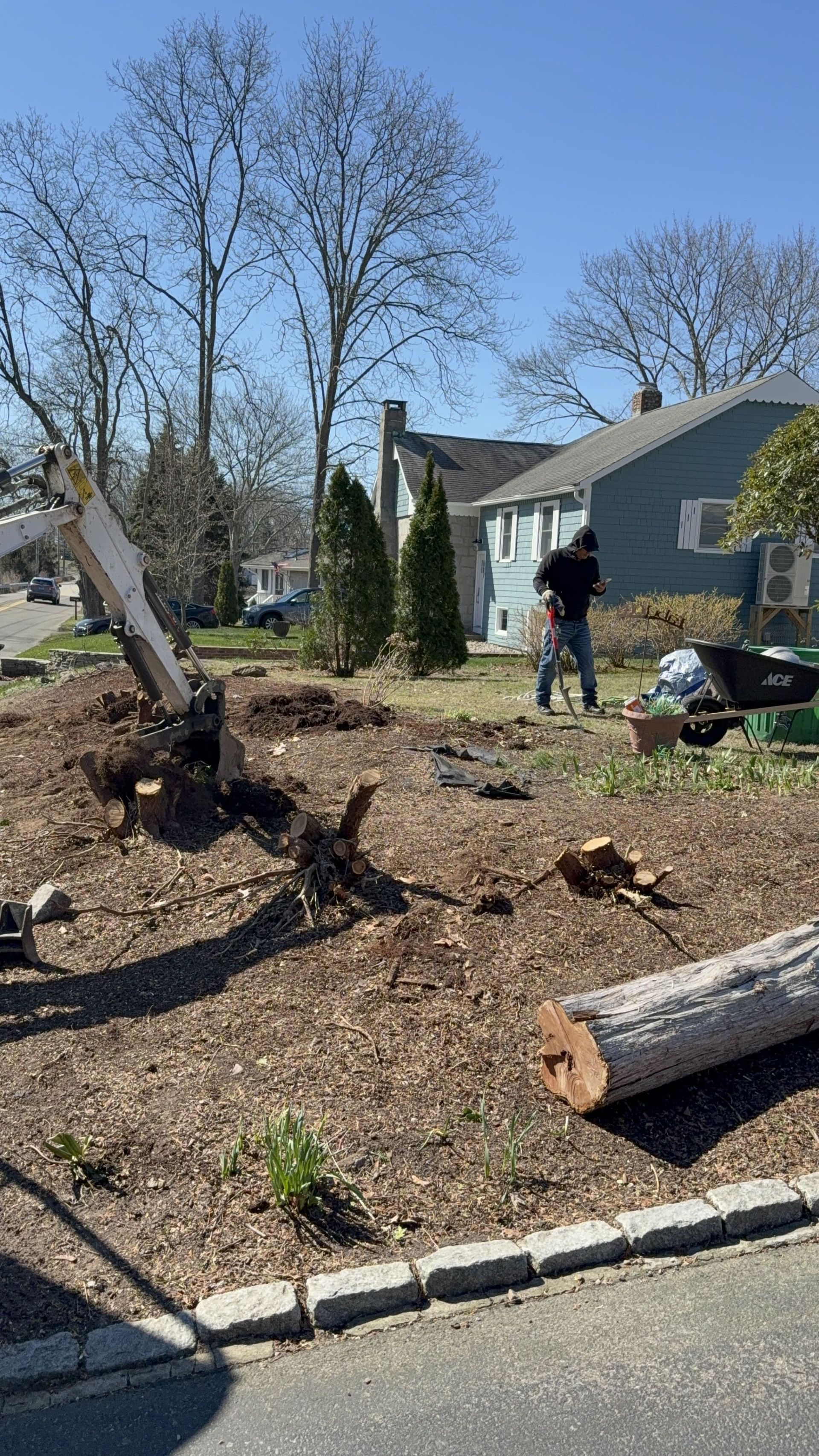
Many established shoreline neighborhoods were built with narrower driveways, smaller side yards, mature landscaping that has grown in over decades, and lot configurations from an era before large service vehicles were a design consideration. A tree growing between a house and a fence line, a tree in a backyard with no vehicle access from the street, or a tree positioned where overhead utility lines block any crane lift path, are all situations a bucket truck or crane simply cannot reach.

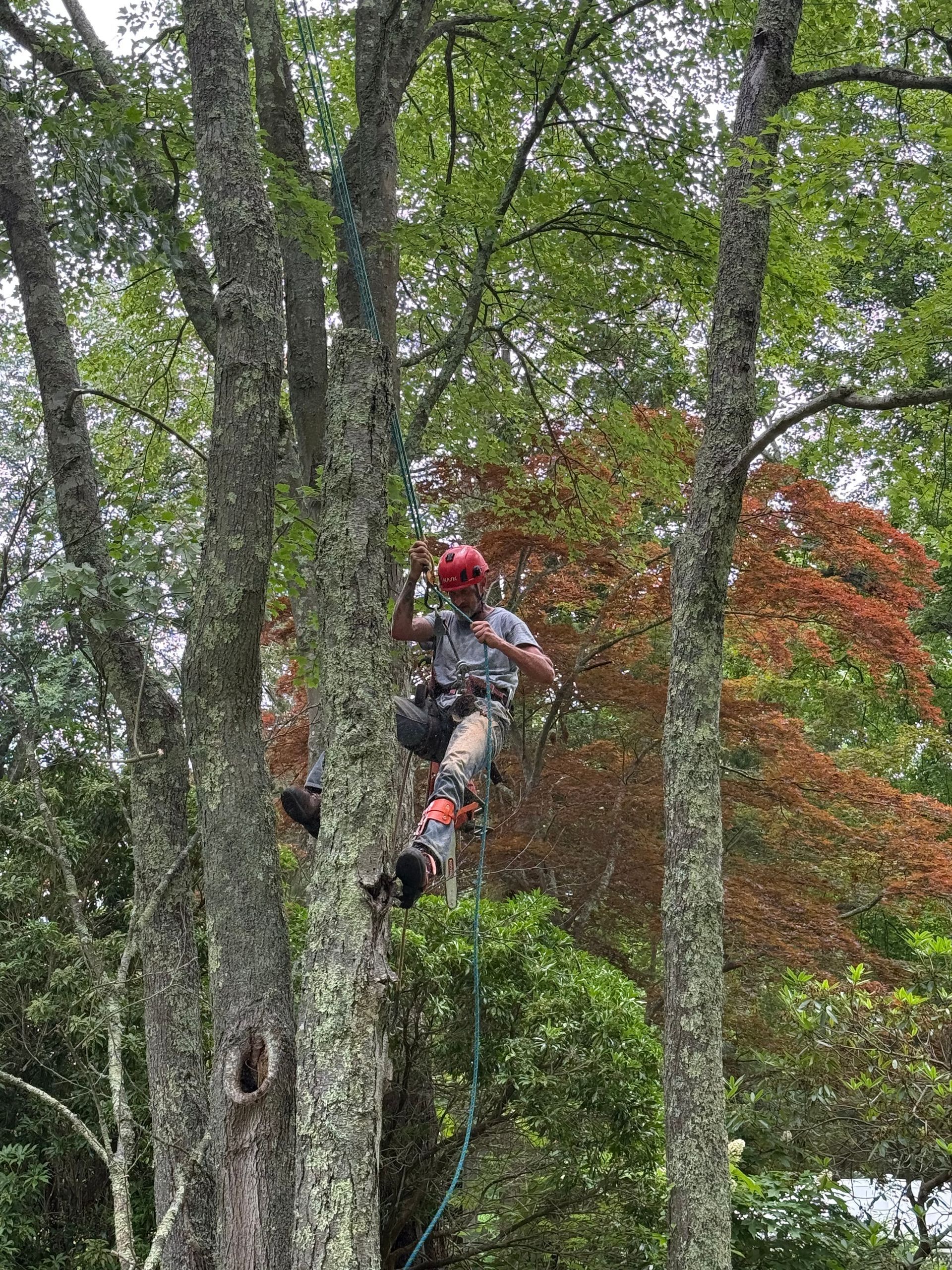
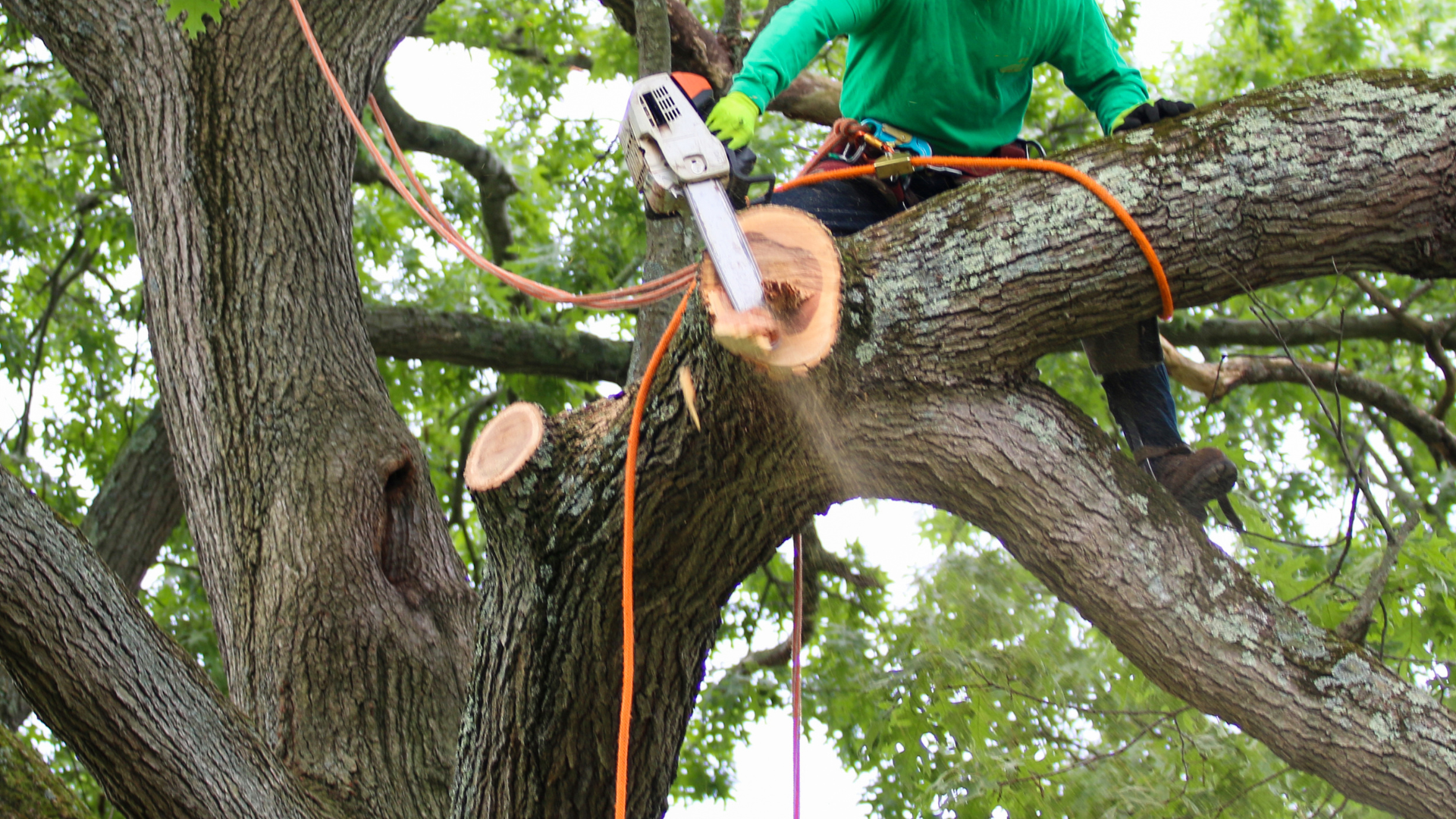
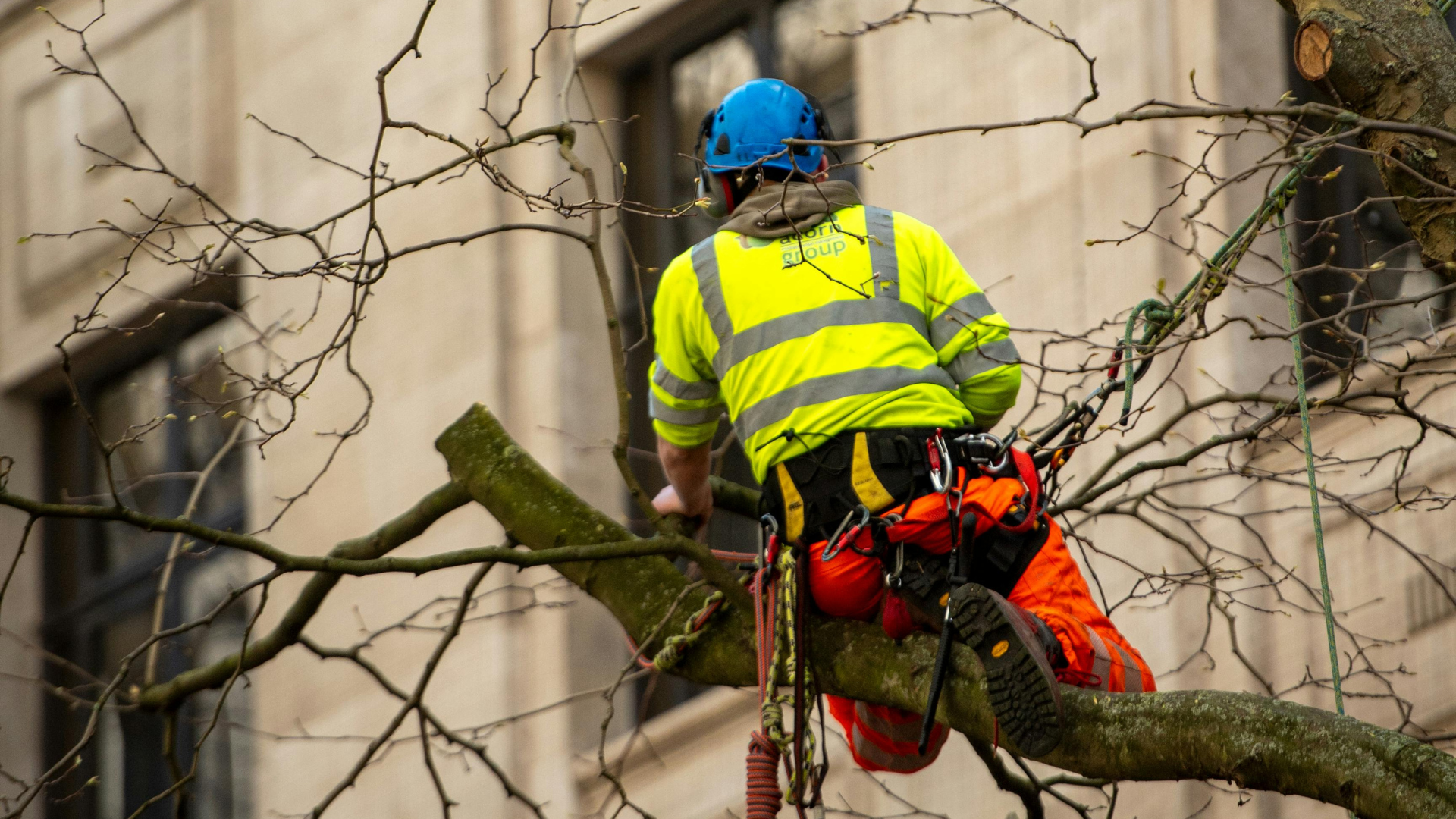
A climbing specialist requires none of this ground access. A climber ascends the tree itself using ropes, harnesses, and rigging equipment, working entirely from within the canopy. There is no vehicle to position, no clearance to secure, and no ground footprint required beyond what the climber and ground crew need to stand safely. For the significant share of CT Shoreline emergency tree calls that involve exactly this kind of constrained residential access, climbing is not one option among several. It is the only method that gets the job done.

Reason 2: Storm-Damaged Trees Near Structures Require Section-by-Section Control That Felling Cannot Provide

When a tree is healthy and in open space, felling, cutting the tree at its base and allowing the entire tree to fall in one direction, can be an appropriate and efficient method. When a tree is storm-damaged and standing next to a house, a garage, a fence, or a neighboring property, felling is not a safe option, because the entire premise of felling depends on having a clear fall zone and a tree whose behavior under the cut is predictable.

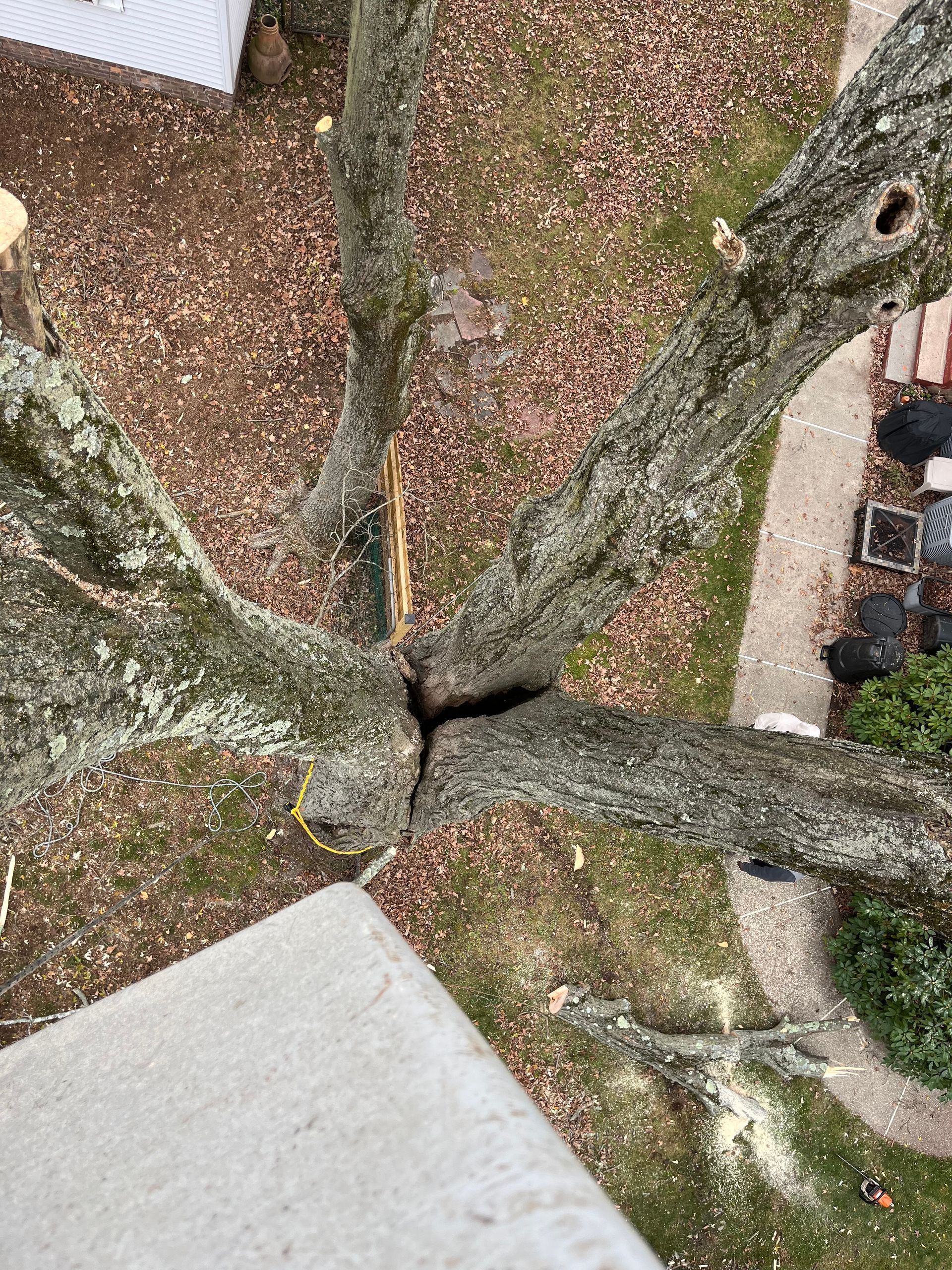
Storm-damaged trees on Connecticut shoreline properties rarely meet either condition. A tree that has been partially uprooted by a nor'easter, a trunk that has split but not fully separated, or a tree leaning against a structure after high winds all have unpredictable internal stress and no safe direction to fall, because the structure that the homeowner is trying to protect is exactly where the tree is leaning.

What a climbing specialist does differently: Rather than committing to a single fall direction for the whole tree, a climber ascends and removes the tree in controlled sections from the top down, using rigging systems to lower each cut section to a designated point on the ground rather than letting it fall freely. This section-by-section approach is significantly more labor-intensive than felling, but it is the method that protects the structure, the neighboring property, and the crew when the tree's behavior cannot be predicted with confidence.

Rigging in this context allows precise control over how each tree section is lowered, minimizing the chance of branches falling unpredictably, and is especially reliable in confined spaces with obstacles, which describes nearly every emergency tree situation involving a structure on a Connecticut shoreline property.

For a White Oak Tree & Landscaping climbing specialist responding to a storm-damaged tree leaning toward a Madison home or split across a Guilford driveway, the ability to control the descent of every individual section, rather than relying on a single predictable fall, is what separates a controlled removal from a second incident on top of the first.

Reason 3: Structurally Unstable Trees Are Often Too Dangerous to Send a Climber Up, Which Is Exactly Why Specialist Judgment Matters

This reason is counterintuitive on its surface: a tree emergency requires a climbing specialist, but the specialist's first job is sometimes determining that the tree is too unstable for direct climbing at all.

Dead, decaying, or brittle trees, including those compromised by disease, pest damage, or storm-related internal fracturing, present a specific risk: a climber's weight and movement on a structurally compromised trunk or major limb can trigger the very failure the removal is meant to prevent. This is the assessment judgment that an experienced climbing specialist brings to every emergency call, evaluating the tree's structural integrity before committing to a climbing approach, and recognizing when a different method, supplemental rigging from an anchor point, ground-based cutting of accessible sections, or in rare cases bringing in crane support for an otherwise inaccessible job, is the safer path.

Why this judgment matters specifically for emergency calls: Emergency tree situations are, by definition, situations where something has already gone wrong: a storm has passed through, a tree has already partially failed, or visible signs indicate the tree is actively unsafe. These are precisely the conditions under which an inexperienced crew is most likely to make the wrong call about whether and how to climb. White Oak's climbing specialists bring the structural assessment experience that comes from 35 years of evaluating compromised trees on Connecticut shoreline properties, distinguishing between a tree that can be safely climbed and dismantled section by section, and one that requires a different approach entirely.

This is the distinction between a tree service that defaults to climbing because that is the only method the crew knows, and a climbing specialist who climbs because the assessment confirms it is the correct and safest method for that specific tree, in that specific condition, on that specific property.

Reason 4: Precision Matters More When the Margin for Error Is a Roofline, a Fence, or a Neighbor's Property

The defining characteristic of tree emergencies on the Connecticut shoreline is proximity. The tree that needs to come down is rarely standing in open space. It is leaning over a roof in Branford, hanging above a driveway in Old Saybrook, or threatening a shared property line in Guilford, which means every cut made during the removal has a target that cannot be allowed to be hit.

A climbing specialist working from within the canopy has direct visual and physical access to every cut point, allowing a level of precision that ground-based or equipment-based methods cannot replicate in tight quarters. The climber can assess each section individually, determine the safest rigging point and lowering path for that specific piece, and adjust in real time based on what the tree's condition reveals as the work progresses, something that is far more difficult to do from the remove of a bucket lift or crane cab, and essentially impossible during a felling cut where the entire tree commits to a single trajectory at once.

What this precision protects on a CT Shoreline emergency call:

  • The structure the tree is threatening: The roofline, siding, or foundation that prompted the emergency call in the first place
  • Surrounding landscaping and hardscape: Mature plantings, stone walls, patios, and walkways common throughout established shoreline properties, which a section-by-section controlled removal preserves far better than a method that drops large sections without precise placement
  • Neighboring property: On shoreline lots where homes sit closer together than in newer suburban development, a removal that goes even slightly wrong can damage a neighbor's roof, fence, or vehicle, creating a liability situation in addition to the property damage itself
  • Utility lines: Many established Branford, Madison, and Guilford neighborhoods have overhead service lines running through or near mature tree canopies, and section-by-section climbing removal allows the kind of careful clearance management that prevents utility contact during the work

What This Means When You Are Calling for Emergency Tree Service on the CT Shoreline

A homeowner facing a tree emergency in Branford, Madison, Guilford, or Old Saybrook is rarely in a position to evaluate, in the moment, whether the crew showing up has the right capability for the specific tree and the specific property. The questions worth asking before any crew begins work include whether the team includes climbing specialists or relies solely on equipment that requires ground access, whether the crew has assessed the tree's structural stability before committing to a removal method, and whether the company has documented experience with confined residential properties similar to the one in question.

White Oak Tree & Landscaping is a climbing specialist operation that has served Clinton, Branford, Madison, Guilford, Old Saybrook, Old Lyme, and the surrounding Connecticut shoreline communities since 1991. The team has spent 35 years working in exactly the confined, structure-adjacent, access-limited conditions that define most residential properties on this coastline, which means the climbing approach is not a workaround for jobs the crew cannot otherwise handle. It is the standard method, applied with the judgment that comes from decades of doing it correctly on properties just like yours.

For tree emergencies that cannot wait, White Oak provides emergency response throughout the CT Shoreline, with climbing specialists equipped to assess and address storm-damaged, structurally compromised, and access-limited trees that other crews are not positioned to handle safely.

Share this article

Recent Posts

Orange excavator lifting a tree trunk beside a house in a suburban yard
By Mike James July 7, 2026
Not every blocked water view needs full tree removal. Learn when White Oak recommends canopy thinning, selective removal, or both for CT shoreline properties.
Pruning shears cutting bare tree branches against a blue sky
By Mike James June 22, 2026
Tree pruning is not just about appearance. White Oak Tree & Landscaping explains what pruning actually involves, the ANSI A300 standards that govern it, and why the trees on your Connecticut shoreline property need it regularly.
By Mike James June 17, 2026
Not every tree service in Clinton CT is qualified, insured, or licensed the way Connecticut law requires. White Oak Tree & Landscaping explains exactly what to verify before anyone sets foot in your yard.
A fallen tree blocks a residential street after storm damage, with a damaged house and power lines nearby.
By Mike James June 15, 2026
Some trees on Connecticut shoreline properties are past the point of waiting but haven't failed yet. White Oak Tree & Landscaping explains the warning signs, the window, and why acting now costs less than acting after.
At-risk tree near a home in Clinton CT requiring professional removal
May 27, 2026
Learn the warning signs of at-risk trees Clinton homeowners shouldn't ignore. White Oak Tree & Landscaping offers free hazardous tree removal assessments.