What Is At-Risk Tree Removal? The Warning Signs Clinton Homeowners Shouldn't Ignore
That old oak in your backyard has been there longer than you've owned the house. You've watched it through every nor'easter and ice storm the Connecticut shoreline could throw at it. But lately, something looks different. There's a lean you don't remember. A crack running up the trunk. Mushrooms growing at the base that weren't there last spring.
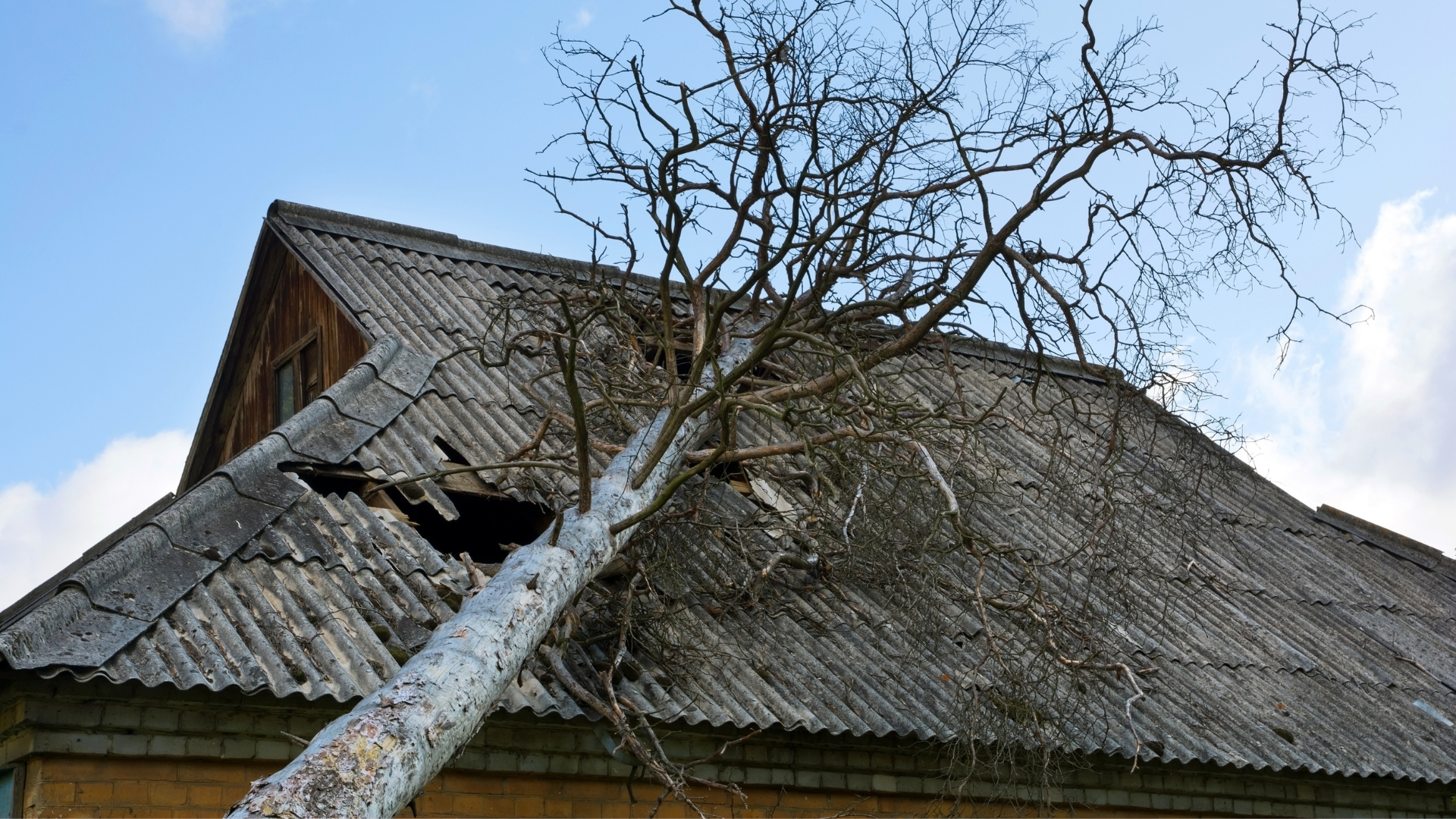
Here's the hard truth most homeowners don't hear until it's too late: trees don't announce when they're about to fail. By the time a structurally compromised tree comes down, the damage - to your roof, your car, your neighbor's property - is already done.
This guide covers exactly what at-risk tree removal means, the specific warning signs Clinton homeowners should watch for, and why acting early is always safer and less expensive than waiting for an emergency.
If you already see warning signs and want a professional eye on your tree, White Oak Tree & Landscaping has been assessing and removing hazardous trees in Clinton since 1991. Call us at (203) 429-5660 for a free on-site assessment.
What Is At-Risk Tree Removal?
At-risk tree removal - also called hazardous tree removal - is the safe, controlled removal of a tree that poses a realistic threat of failure. Not every dead branch means a tree is at-risk. Not every tree that leans needs to come down. But when structural defects, disease, root failure, or storm damage reach a point where a tree could fall or shed major limbs without warning, it moves from a landscaping concern into a genuine safety and liability issue.
The challenge is that most at-risk trees look perfectly fine from a distance. A healthy-looking canopy can mask a hollow trunk. A full set of leaves doesn't mean a tree's root system is intact. That's why identifying at-risk trees requires more than a glance from the driveway - it requires an experienced eye that knows what to look for at ground level, up the trunk, and inside the canopy.
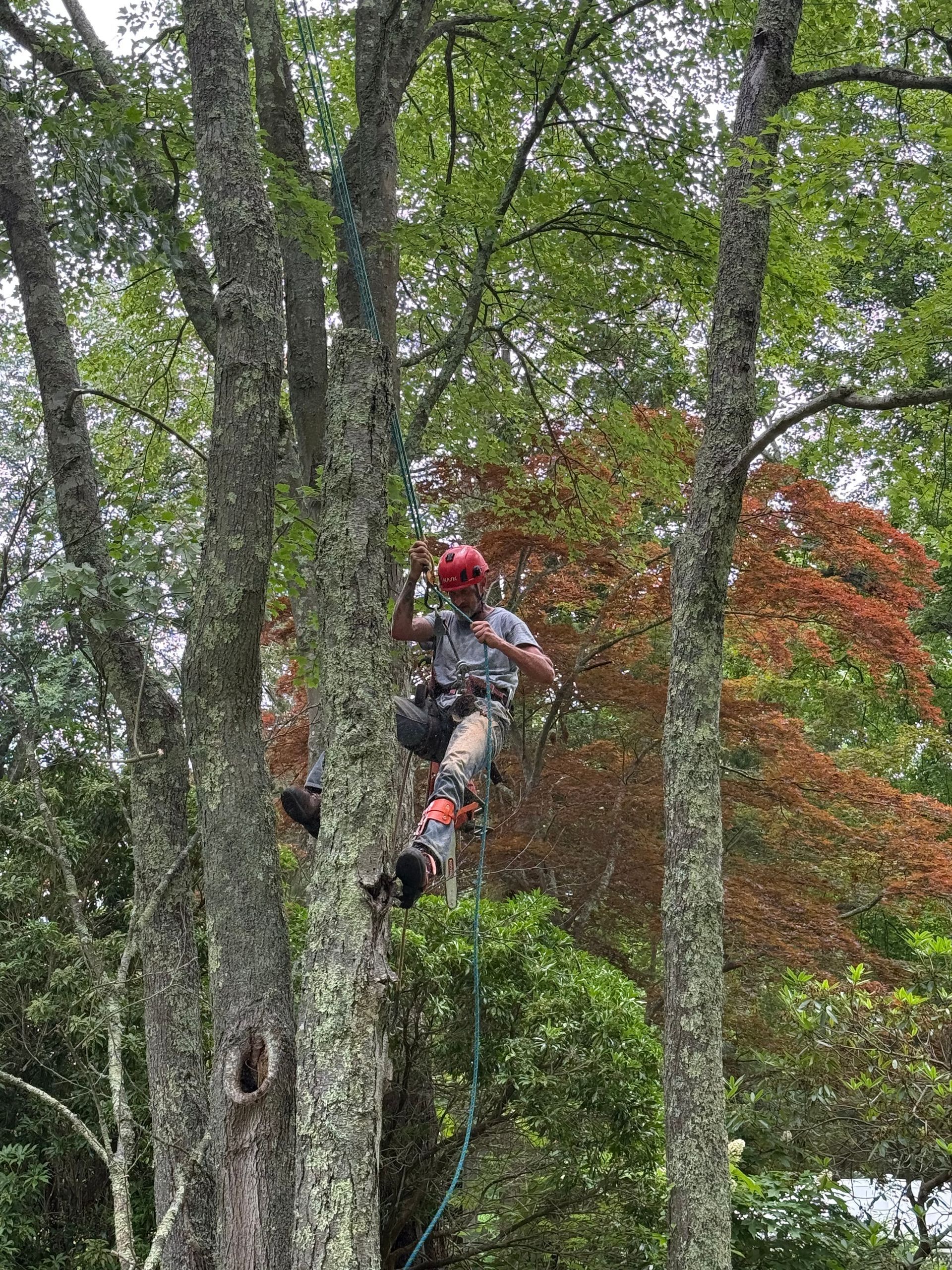
White Oak's hazardous tree removal service is built specifically around trees that other companies walk away from: trees too close to structures, over power lines, leaning toward driveways, or positioned in tight yards with limited equipment access. Our climbing specialists assess from inside the canopy, identify failure points before they become emergencies, and bring the tree down in controlled sections.

7 Warning Signs Your Tree May Be At-Risk
1. Visible Lean - Especially If It's New
A slight lean doesn't automatically mean a tree is dangerous. Many trees grow at a natural angle and remain stable for decades. What matters is change. If a tree that used to stand relatively straight has developed a new or deepening lean - particularly toward your house, driveway, power lines, or a neighboring property - that shift signals root movement or structural failure underground.
Clinton's coastal soil conditions make this especially common. Saturated soil after heavy rain events loosens root anchoring. If you've noticed a change in lean after the last storm season, get it looked at.
2. Cracks or Splits in the Trunk
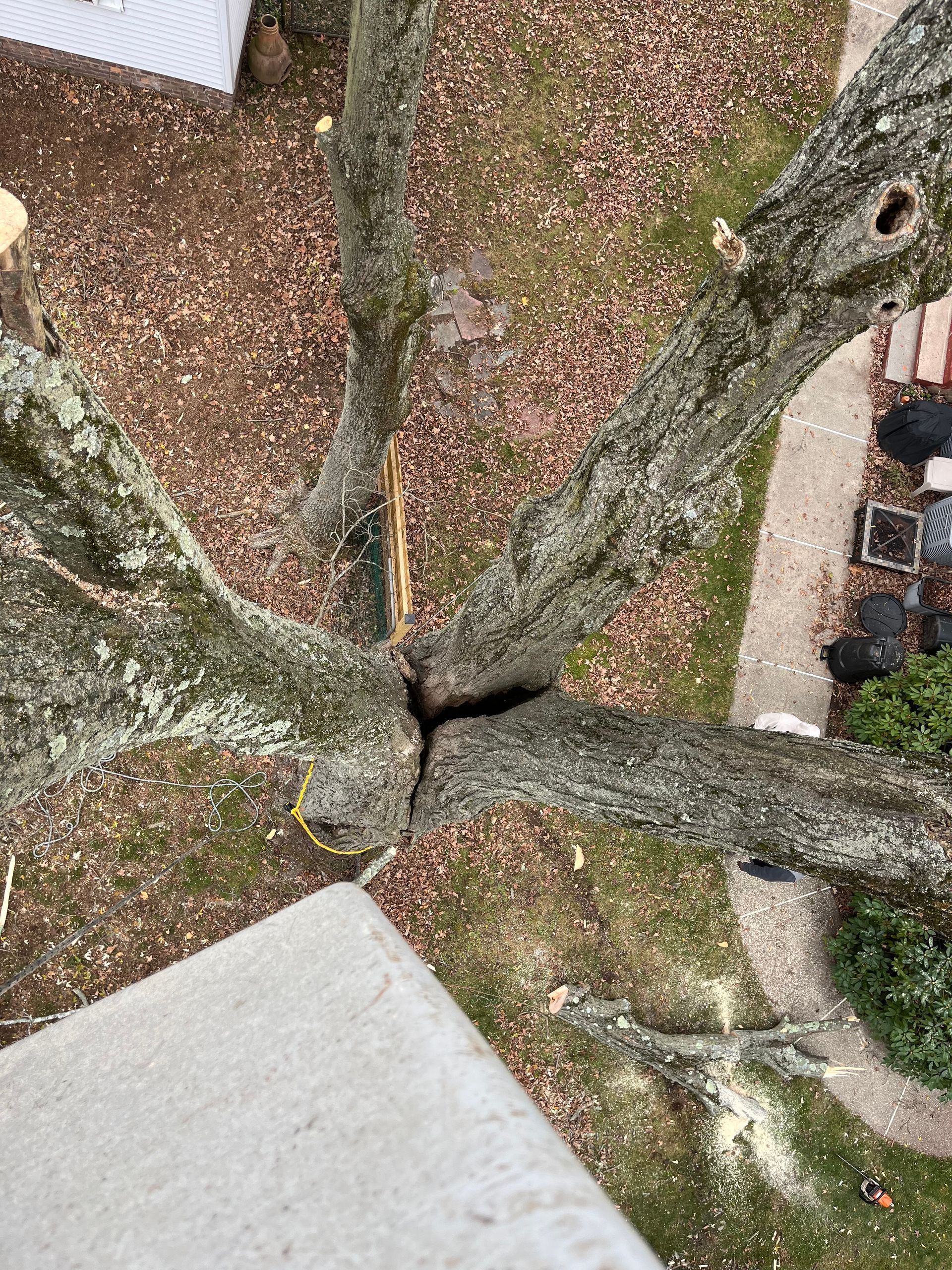
Vertical cracks running along the trunk, or horizontal splits where major limbs attach to the main stem, are serious structural red flags. These are called included bark or co-dominant stem failures in arborist terms - areas where two major trunks or limbs have grown together under tension rather than forming a solid union.
In high-wind conditions, which are common along the Connecticut shoreline between October and April, this type of weakness can fail catastrophically and without much warning. If you see a visible seam, crack, or split - especially one that has widened since the last time you noticed it - that tree needs professional evaluation immediately.
3. Fungal Growth at the Base or on the Trunk
Mushrooms, bracket fungi (sometimes called shelf fungi), and other fungal growth on or near a tree are not cosmetic problems. They are diagnostic signs of internal decay. Fungi colonize dead and dying wood. When you see them growing on a trunk or emerging from the root zone, it means decay has already taken hold inside - often far more extensively than what's visible on the surface.
A tree can look fully leafed-out and healthy above while its interior is significantly compromised. This is one of the most dangerous combinations in hazardous tree assessment: a tree with enough live tissue to support a full canopy, but with internal decay that has undermined its structural integrity.
4. Dead or Hanging Limbs in the Upper Canopy
Individual dead branches are common and manageable with proper tree trimming and pruning. But when deadwood makes up more than 25–30% of a tree's canopy, or when large-diameter dead limbs are hanging directly over your home, vehicle, or high-traffic areas of your yard, you have an active hazard - not a maintenance issue.
Arborists call hanging dead limbs "widow makers" for a reason. They can fall without any trigger: no wind, no storm, no warning. Dead wood loses moisture and becomes brittle, and the attachment point to living wood weakens over time. A large deadwood limb over a roof or patio is not something to monitor through another season.
5. Root Damage or Disturbance Near the Base
The root system is what keeps a tree anchored, and it's almost entirely out of sight. But there are visible clues that root integrity may be compromised:
- Heaving soil at the base, particularly on the uphill side of a leaning tree
- Exposed or severed roots from recent construction, excavation, or driveway work
- Soft, spongy ground around the base where soil has shifted
- Root collar decay - visible rot or discoloration right where the trunk meets the ground
Clinton homeowners with mature trees near driveways, patios, or areas where recent work has been done within the last few years should pay particular attention to root health. A tree can lose a significant portion of its root system and still look healthy for several growing seasons before the structural consequences become apparent.
Our tree removal specialists evaluate root health as part of every on-site hazard assessment.
6. Trees That Have Already Failed Once
Storm-split trees, trees with large broken limbs that have partially torn away, and trees that have shed major sections in previous seasons are inherently compromised. The structural failure point is already established. The remaining portion of the tree is under uneven stress, and the attachment of what's left is often weaker than it appears.
If your tree has already "partially failed" - a major limb came down, the top broke out, or a large section tore away in a previous storm - the question is not whether it will fail again. It's when.
White Oak responds to emergency tree situations throughout Clinton and the surrounding shoreline. If you have a storm-damaged tree actively threatening your home or property, call (203) 429-5660 immediately.
7. The Tree Is Too Close to Your Home, Power Lines, or Structures
Location is a risk multiplier. A structurally sound tree growing over your back lawn poses very little danger even if it eventually fails. The same tree growing directly over your roof - or hanging over utility lines - turns any structural weakness into a potential disaster.
If a tree on your Clinton property is positioned so that its full failure would reach your home, your neighbor's home, or active utility lines, that location alone raises the urgency of any structural concern you observe. This is true even for trees that appear relatively healthy. The consequences of failure in that position are severe enough that a professional evaluation is always worth scheduling sooner rather than later.
Why At-Risk Tree Removal in Clinton Requires Climbing Specialists
Most at-risk trees are at-risk precisely because of where they are. They're leaning toward the house. They're growing over the deck. They're wedged between a fence line and a power line with no clear fell path.
Standard tree removal approaches - felling a tree to the ground - simply don't work in these situations. When a tree can't be dropped, it has to come down in sections, with each piece carefully rigged and lowered to avoid the structure, vehicle, or utility line beneath it.
That's climbing work. And it's exactly what White Oak has been doing in Clinton since 1991.
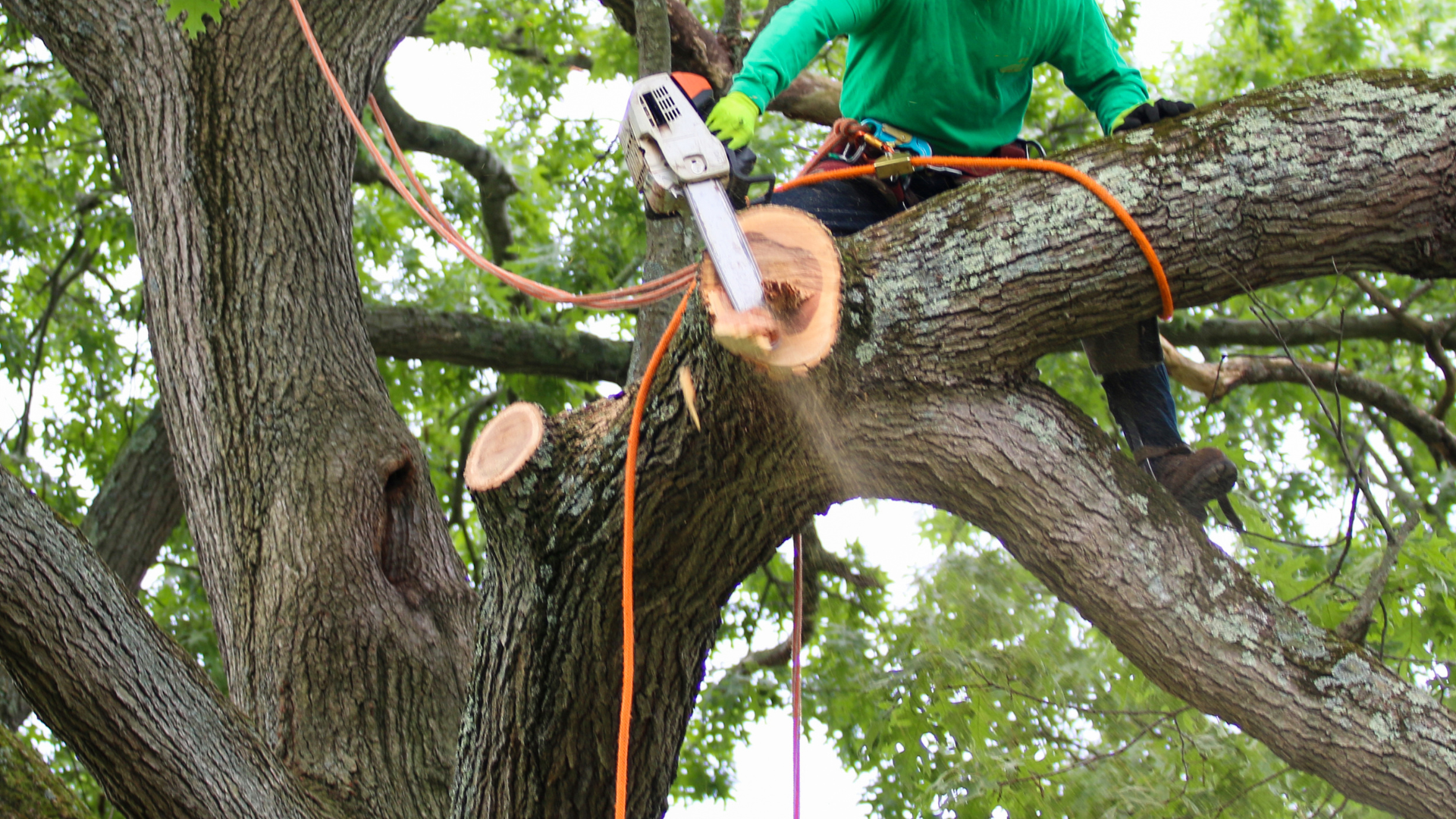
Our climbing specialists work from inside the canopy using ropes and rigging to control each section as it comes down. We assess failure points before we make a cut. We work without the heavy equipment footprint that would tear up your lawn, and we access trees in confined spaces - tight side yards, fenced properties, soft coastal soil - where cranes or bucket trucks simply can't operate safely.
If another tree company has looked at your tree and declined the job, or if you want a second opinion on the safest approach, call us. Hazardous tree climbs are our core specialty, and that's not a marketing line - it's what's built our reputation in this community over 35 years.
The Cost of Waiting: Why At-Risk Trees Are an Urgent Problem
We understand that tree removal is not a small expense. A large, technically complex removal in a tight residential location can run several thousand dollars. It's easy to put off, especially when the tree still has leaves and looks mostly fine.
But consider what the alternative costs:
- Roof damage from a fallen tree or major limb can run $10,000 to $50,000+ depending on the severity, and homeowner's insurance claims often involve disputes over whether the damage was preventable
- Liability exposure if your tree falls onto a neighbor's property or vehicle - especially if you were aware of warning signs and didn't act
- Emergency removal costs after a tree has already failed are substantially higher than proactive removal, because crews are working around the damage in unsafe conditions, often after hours
- Utility restoration costs if your tree takes down power lines
A proactive assessment costs nothing. White Oak provides free on-site evaluations with written quotes for every job. We will tell you clearly if a tree needs to come down, if trimming is the right answer, or if the situation can be monitored through another season.